
When a water softener is not softening, the spots, scale and soap that will not lather come back. Other faults look different: salt that never goes down, water that tastes salty, a clock on the softener that flashes.
This is water softener troubleshooting by the book, and the book is the Hellenbrand ProMate 6 troubleshooting table on page 9. It comes from Rev E of Hellenbrand's ProMate 6 consumer's manual (800527). Older units may have shipped with a different revision, and other brands and models have their own manuals.
Range Water Conditioning calls the ProMate 6 single-tank softener its go-to for most residential installations, so its manual is the one used here. The EPA WaterSense softener guide says installing and maintaining a softener according to manufacturer instructions will prevent damage and unnecessary water and salt use.
The page 9 table sorts each fault into owner fixes and dealer calls
The table has three columns (Problem, Cause, Correction) and 14 numbered problems, each with lettered causes and matching corrections. "Row 5B" here means cause B of problem 5.
Plenty of corrections name no dealer: set the bypass valve, add salt, reset the clock, replace a battery, plug in the transformer, run an extra regeneration. Ten end with a call to a Hellenbrand dealer for onsite service, and four of those ten (rows 7B, 10C, 13B and 14B) only if the problem persists.
Salt keeps coming up for a reason. Hardness collects on the resin until the softener "can no longer soften water" and is "exhausted." Regeneration is how a softener recharges its resin with brine: a brine (salt) solution rinses the resin, the hardness is replaced with sodium, and the hardness minerals go down the drain. Which is why the table's hard water row lands on the bypass valve and on salt.
Water softener troubleshooting starts at the bypass valve
Three rows point at one valve. Row 3 is a control valve that "does not regenerate automatically but does when REGEN button is depressed," caused by a bypass valve sitting in the bypass position. Row 5A is hard water with the bypass "open or faulty." Row 13A is no "softening" or "filtering" display while water is flowing, with the bypass valve in the bypass position as its cause again. The correction each time is to put the valve in the service position, and row 3 sends you to the diagram on page 6.
Page 6 draws the valve in four positions. The two to hold yours against here are Figure 3 and Figure 4. Figure 3 is labeled NORMAL OPERATION: both knob handles upright, in line with the ports, and the water leaving labeled "TREATED" WATER EXITS. Figure 4 is labeled BYPASS OPERATION: both handles turned sideways, and the water leaving labeled SUPPLY WATER EXITS. Neither drawing carries the words "service position," so compare the handles, not the captions. If your handles match neither figure, the page draws two more positions.
If you bypassed the softener on purpose, EPA WaterSense says to return the valve to its previous position afterward, so water goes back through the softener.
Row 5A's cause also says "faulty," and the table gives that one cause a single correction covering both words: put the bypass in the service position. It gives no separate step for a faulty valve. The manual puts its general instruction for service work on page 2, in the dealer section below.
Keep the salt above the water line, at the level the manual sets
Row 5B is the table's other cause of hard water: "No salt or low salt level in brine tank." The correction is "Add salt to brine tank and maintain salt level above water level."
How fast the salt goes depends on how much water you use, so Hellenbrand's ProMate 6 manual has you check the level "every couple of weeks initially to determine how much salt you use." That is a first check to learn your own rate, not a schedule for life. Fill the tank "approximately three-fourths full," with at least 12 inches of salt.
A home that uses little water gets a lower ceiling. In the manual's words: "If your household does not use much water, do not fill your brine tank over 1/2 full, salt bridging may occur in the brine tank. This may result in hard water due to ineffective regeneration."
Water in the tank is not always visible. The manual says the softener is "factory programmed with the Prefill option," and that when programmed as Prefill, "you will typically not see water in the brine tank unless salt supply is low and needing to be replenished." Prefill also rules out one kind of salt, in the manual's capitals: "DO NOT USE Block Salt when the ProMate control is programmed with a brine tank prefill," because it dissolves too slowly for a good regeneration.
Which salt to buy is a question the manual sends to your dealer. EPA WaterSense's general advice is sodium or potassium pellets made for softeners, not rock, road or table salt. If the tank does run out, EPA says the water will not soften and you waste water and energy.
A salt level that is not going down can mean a bridge or a clogged brine well
Hellenbrand warns that bridging may occur but gives no way to find or break a bridge. EPA WaterSense does.
If the salt level is not going down over time, EPA says the cause could be salt bridging or clogging in the brine tank. A bridge, in EPA's description, is a hard layer in the middle of the tank. It keeps the pellets from falling to the bottom, and it keeps the suspended salt from mixing properly with the water below to form brine. Filling to the top is one cause EPA names. EPA's fix is a broom handle or similar item to break up the bridge, then a regeneration cycle.
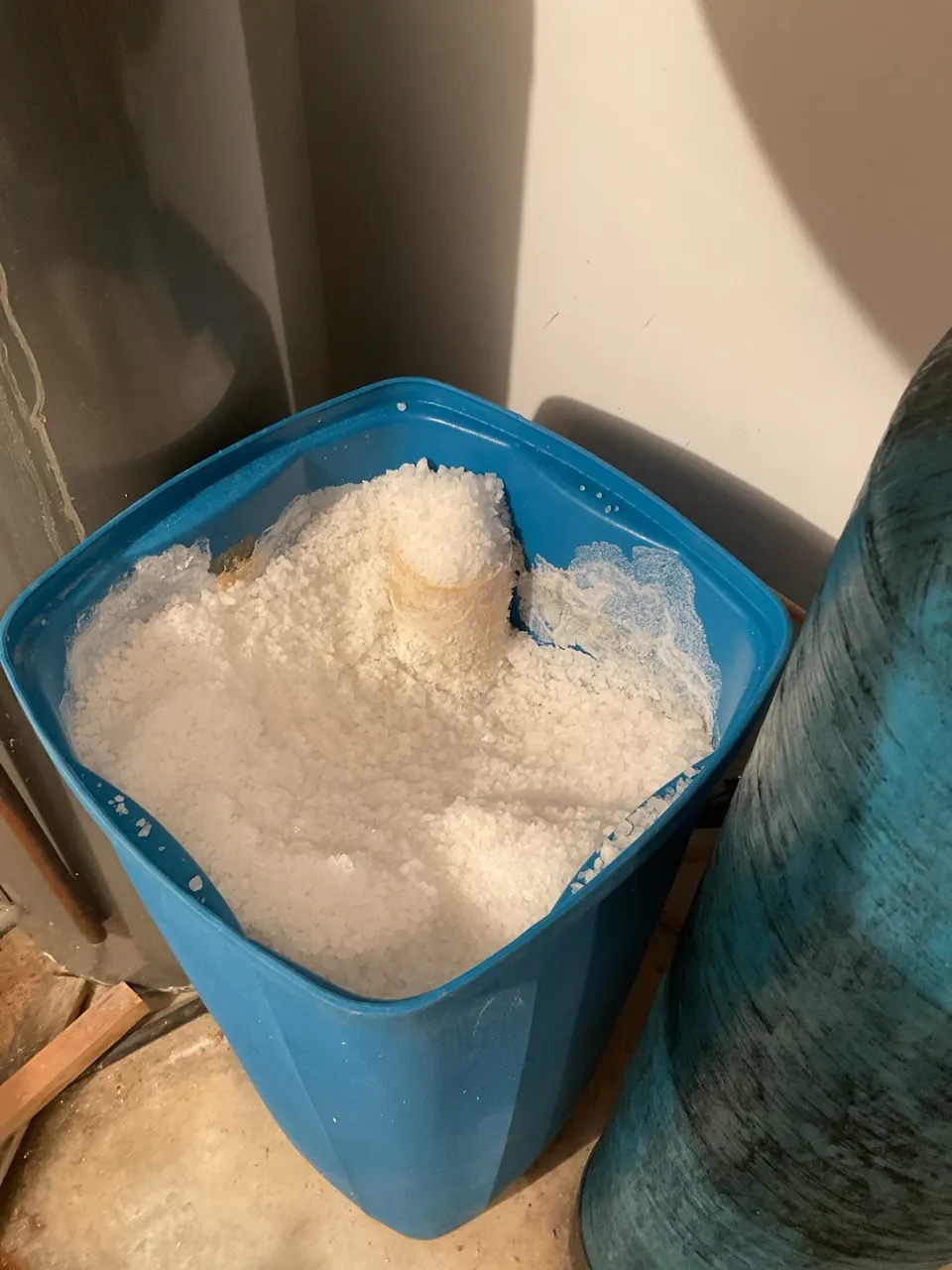
Clogging, in EPA's terms, is salt hardened over the openings in the brine well, so water cannot move between the brine tank and the media tank. EPA's steps for clearing a clog:
- Pour a gallon of hot tap water into the brine tank.
- Let it sit for about 10 minutes.
- Break up the clogging with a broom handle.
- Run a regeneration cycle once the clogging has cleared.
Hot water can also loosen a persistent salt bridge, EPA says. On a ProMate 6, either regeneration starts at the REGEN button.
Press REGEN once to regenerate later, or hold it five seconds to start now
To manually regenerate a ProMate 6 softener, press REGEN one of two ways. The manual's own example of when to regenerate early is heavy water use "because of guests or a heavy laundry day." EPA's advice to run one after breaking a salt bridge is another reason.
Press and release REGEN, and the softener regenerates at "the preset delayed regeneration time." "REGEN TODAY" flashes on the display, and pressing the button again cancels the request. The factory setting for that time is 2:00 a.m., but it is an installer setting, so yours may differ.
Press and hold REGEN for five seconds, and regeneration starts immediately. Be sure first. In the manual's words, "The request cannot be cancelled. You must cycle all the way through the cycles to make it stop." It also resets the meter. That is ProMate 6 behavior.
Check the salt before either one. If the salt tank was empty, the manual says to fill it and wait at least two hours before regenerating.
Salty water gets one owner fix before it becomes a dealer call
Row 7, "Softener delivers salty water," has two causes. Cause A is "Low water pressure," and the correction is "Run extra regeneration." On a ProMate 6, either REGEN press above runs one. The press-and-hold method starts it immediately, on the no-cancel terms above.
The manual does print a pressure figure, but not in row 7 and not as a threshold for it. The pre-installation check list gives an installation requirement: regeneration needs a minimum of 25 psi (pounds per square inch) of water pressure, with a maximum of 125 psi. Nothing in the table says what pressure counts as low.
Cause B is "Excessive water in brine tank." The correction: "If problem persists, contact your local Hellenbrand dealer for onsite service."
A flashing clock on the softener points to the backup battery or an older board
On a ProMate 6 softener, row 4 gives two causes for a flashing clock. Row 4A says the battery backup maintains the time of day for up to 2 years in a power outage as long as the battery is not depleted, and "Time of day flashes when battery is depleted." The fix is a new lithium coin type 2032 battery on the PC board (the control's circuit board), then a time reset. Only the time of day needs resetting, the manual says, because all other values are stored in non-volatile memory.
Row 4B covers boards made before 2007, which had no battery backup. A capacitor held the time for up to 2 hours, so a longer outage means resetting the time of day. The manual also notes, "Battery back-up feature will be activated after 24 hours of power," and "Do not forget to reset for daylight savings time."
To set the clock, the manual's steps are:
- Press SET CLOCK.
- Set the hour with the up or down arrow. AM/PM toggles after 12.
- Press NEXT and set the minutes.
- Press NEXT to exit.
Row 14, regeneration at the wrong time of day, gets the same reset, then a dealer call if the problem persists.
A blank screen starts at the plug. Row 11A pairs an "Absent or incomplete LCD display" with an unplugged transformer: "Plug transformer into uninterrupted outlet." The manual's pre-installation check list adds that the supply should be "uninterrupted and cannot be turned off with another switch." Row 11's other causes are a depleted battery (the same 2032 type) and a defective transformer, a dealer job.
Check the hardness setting against a fresh test of your water
The Minnesota Department of Health's home water softening page says, "Make sure the softener is set to the hardness of your water supply. If the hardness is set too high, the softener will cost more to operate and waste water, costing you extra money."
A ProMate 6 takes that setting in grains per gallon, so how hardness is measured in grains per gallon is worth knowing first. The manual calls the value "total compensated hardness" and puts it in the Installer Displays/Settings (factory setting 20, range 1 to 150). Changing that number belongs with a fresh test and a service visit, not with a poke at the front panel.
The manual's contents even call the step "Test Water and Set Hardness." A free in-home water test reads hardness on the spot. The MDH home water treatment facts page says that after installing treatment, you should test the treated water to make sure the treatment is working.
Hellenbrand's ProMate Twin Alternating consumer's manual (800671) lists "Raw water hardness fluctuation" as a cause of hard water, corrected by testing and adjusting "settings to highest known hardness." The ProMate 6 table has no such row.
Inspect the brine tank at least once a year and clean it periodically
The manual says to inspect the brine tank at least once a year for a build-up of insoluble materials, and to clean it periodically whatever salt you use.
The cleaning steps are in the Maintenance section, printed on page 8, though the manual's own cross-references point to page 7. In short: scoop out the old salt, disconnect the brine tubing, and remove the safety brine valve, overflow, brine well and grid plate (if used). Wipe and rinse with clean water, reassemble, add 6 inches of water and add new salt. Old salt goes back only if it is clean and not mushy, and Hellenbrand's own line is "We recommend using new salt."
The next-to-last step points to the disinfection instructions on page 7. MDH says to read the manufacturer's instructions before adding any chemicals to the unit.
Ten corrections in the table end with a call to a Hellenbrand dealer
In the table below, "dealer" is short for the manual's instruction to contact your Hellenbrand dealer for onsite service.
| Problem | Cause the manual gives | What the manual says |
|---|---|---|
| 1. Control valve stalled in regeneration | Motor not operating | Verify power supply at outlet, then dealer |
| 2. Control valve does not regenerate automatically when REGEN button is depressed and held | Does display show an error code | Dealer |
| 6. Unit uses too much salt | Improper brine refill setting | Dealer |
| 7. Softener delivers salty water | Excessive water in brine tank (7B) | Dealer, if problem persists |
| 8. Continuous flow to drain | Piston position error | Dealer |
| 9. Loss of water pressure | Iron build-up in resin, resin bed fouled | Dealer |
| 10. Iron in softened water | Control fails to regenerate (10C) | Dealer, if problem persists |
| 11. Absent or incomplete LCD display | Defective transformer (11C) | Dealer |
| 13. No "softening" or "filtering" display when water is flowing | Meter connection disconnected (13B) | Connect meter to PC board, then dealer if problem persists |
| 14. Control valve regenerates at wrong time of day | Time of day not set correctly (14B) | Reset time of day, then dealer if problem persists |
The manual lists no error codes and explains none. Row 10's causes also include an iron-fouled resin bed and a failed prefilter, and the correction for the fouled resin bed includes installing an Iron Curtain System ahead of the softener (Range Water's page on Iron Curtain iron filters covers those systems).
Page 2 of the manual says who to call: "In the event that you need professional assistance for servicing your water softener, please contact the dealer who installed this system." The same page has blank lines for the dealer's name and phone number. Page 7 shows a display screen with a dealer name and phone number, captioned "May display if service is required."
Range Water Conditioning is a factory-authorized Hellenbrand dealer. Its page on softener service and repair says its certified technicians can service and repair most water treatment systems and that "We service and repair all brands, not only the systems we installed," with a shorter limited-service list of five brands set out separately. The page names Hellenbrand control valve and motor repairs, and says the service trucks carry common Hellenbrand parts such as control valve components, motors, seals and circuit boards. For ProMate 6 maintenance it lists checking the resin bed, inspecting the control valve, verifying regeneration cycles and checking salt levels.
Other brands and models follow their own manuals
Apart from the one Twin Alternating row in the hardness section, every row quoted here comes from the ProMate 6 Rev E table. Other brands and models have their own manuals, and EPA WaterSense and MDH both say to install and maintain a softener according to the manufacturer's instructions.
Range Water's service page names Hellenbrand, Hellenbrand Millennium Pro+ and EcoWater among the major brands it works on. The five on its limited-service list are Brassmaster, Hague, Turbo Soft, Hydrotech and Canature, and it asks those owners to call to discuss their system.
The company has been family owned and locally operated since 1969, with locations in Grand Rapids (218-322-0575), Duluth / Hermantown (833-659-5553) and Pequot Lakes (218-322-1793). Call the nearest one, or get in touch through the contact page.
Frequently asked questions
Why is my water softener not using salt?
EPA WaterSense says a salt level that is not going down over time could mean salt bridging or clogging in the brine tank. EPA's fix for a bridge is to break it up with a broom handle or similar item, then start a regeneration cycle. Rev E of the ProMate 6 manual warns that a household that does not use much water should not fill the brine tank over half full, because salt bridging may occur.
How can I tell if my water softener is working?
Test the softened water for hardness. Range Water's free in-home test reads hardness on the spot. On a ProMate 6, watch the display while water runs. The manual says "GPM" flashes on screens other than the flow rate when water is flowing through the system, and the table lists a missing "softening" or "filtering" display at that moment as a fault (row 13), with the bypass valve in the bypass position as its first cause. MDH says regular testing of the water and maintenance of the softener are necessary to make sure it is working properly.
How often should a water softener regenerate?
No single number fits every home. A ProMate 6 calls for a regeneration based on gallons used. Its day override, an installer setting, also calls for one after a set number of days even if not enough gallons were used (factory setting 14 days, range 1 to 28, or off). The display shows Days To A Regen and Capacity remaining, so you can see where your unit stands. The hardness setting is an installer value too, and MDH says a hardness set too high makes the softener cost more to operate and waste water.
What should I do if my softened water tastes salty?
Row 7 of the ProMate 6 table covers salty water. Cause A is low water pressure, and the correction is to run an extra regeneration. Pressing and holding REGEN for five seconds starts one immediately, but it cannot be cancelled and it resets the meter. Cause B is excessive water in the brine tank, and the correction is to contact your local Hellenbrand dealer for onsite service if the problem persists.
Which water softener problems can I fix myself?
On the ProMate 6 table, the corrections that name no dealer include setting the bypass valve to the service position, adding salt, resetting the clock, replacing the 2032 coin battery, plugging in the transformer and running an extra regeneration. Ten corrections end with contacting a Hellenbrand dealer for onsite service, among them a control valve stalled in regeneration and continuous flow to the drain. For professional help, page 2 of the manual says to contact the dealer who installed the system. Other brands follow their own manuals.
Sources
Hellenbrand (Franklin Water Treatment, LLC), Consumer's Manual, ProMate 6 Series, 800527 Rev E.
Hellenbrand (Franklin Water Treatment, LLC), Consumer's Manual, ProMate Series Twin Alt, 800671 Rev D.
U.S. Environmental Protection Agency WaterSense, Soften Water Without Wasting It: Guide to Selecting and Maintaining a Water-Efficient Water Softener.
Minnesota Department of Health, Home Water Softening: Frequently Asked Questions.
Minnesota Department of Health, Home Water Treatment Facts.
Share This Article