Iron Filters for Well Water in Northern Minnesota
Orange stains in the sink, black specks in the toilet, a rotten-egg smell from the tap. Our Hellenbrand iron removal systems pull iron, manganese and hydrogen sulfide out of well water, sized to your test.
Serving Grand Rapids, Duluth, Brainerd & surrounding Northern MN.
See Our Systems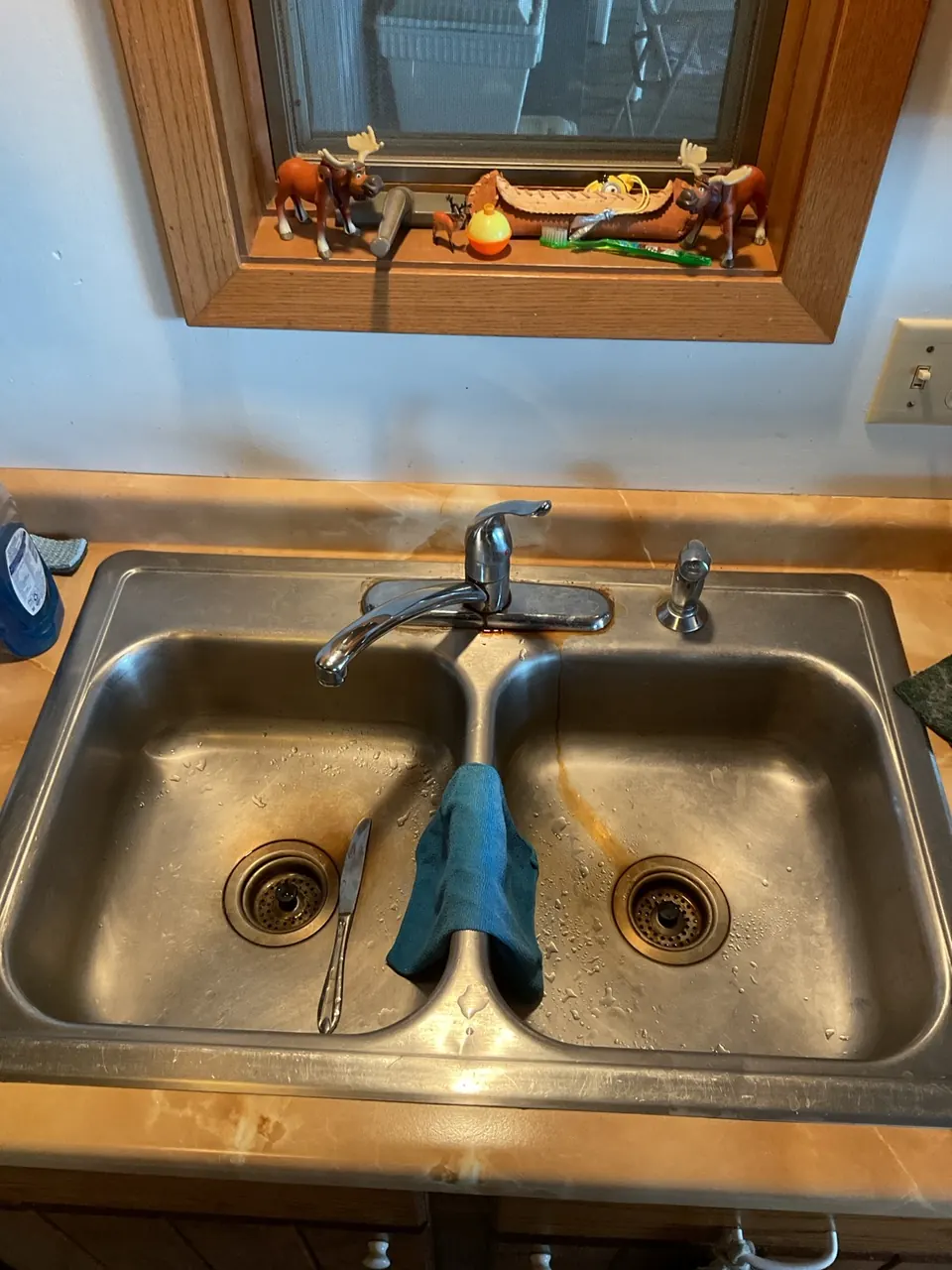
Signs You Have Iron in Your Water
Iron gets into well water as rain and snowmelt soak through iron-bearing soil and rock, and corroding steel casing adds more. Here's how to tell if you have an iron problem:
- Orange or rust-colored stains on fixtures, toilets, and sinks
- Water that runs clear, then turns rusty in the glass ("clear-water" iron)
- Water already red or yellow at the tap ("red-water" iron)
- A metallic taste, a rainbow sheen on coffee and tea, potatoes that cook up black
- Stained laundry with orange or brown spots
- Clogged pipes and reduced water pressure
Black stains usually point to manganese, and black silverware with a rotten-egg smell to hydrogen sulfide. If only the hot tap smells after the water has sat a few hours, the problem is usually the water heater, not the well.
How Iron Removal Works
Both systems work the same way: oxidation first, then filtration. Water passes through a head of air, the oxygen turns dissolved iron, manganese and hydrogen sulfide into solid particles, a media bed catches them, and an automatic backwash flushes them to the drain, normally on a schedule set for a time of low water use.
The oxidizer is plain oxygen, about a fifth of the air in the room. No salt and no chemicals go into your water.
Benefits of Iron Removal:
- Iron caught before it reaches fixtures and appliances
- Clean, bright laundry without discoloration
- Better tasting water without metallic flavor
- Treated water to your indoor fixtures (outdoor faucets are usually left on raw water)

Our Recommended Iron Removal Systems
We install two Hellenbrand iron filters, the ProMate 6 Iron Curtain Jr and the ProMate 6 Iron Curtain 2.0. Both oxidize with air, neither softens water, and both need steady 110 volt power and a freeze-free indoor spot. Choosing an iron filter for well water comes down to your test.
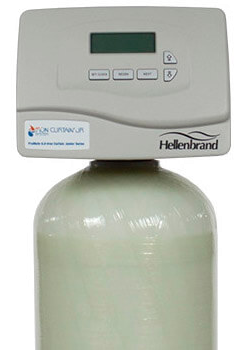
ProMate 6 Iron Curtain Jr
The Jr is the smaller unit, Hellenbrand's value option for moderate iron and light rotten-egg odor. Water passes through a layer of air, and the media bed below catches the iron particles. Each regeneration backwashes the bed and draws in fresh air, more often as your iron rises. If you need softening too, it goes ahead of a separate ProMate 6 softener.
- Air oxidation, no salt and no chemical regenerant
- Automatic backwash cycle keeps the media bed clean
- Standalone iron removal unit, does not soften water
- Hellenbrand recommends a yearly dealer checkup
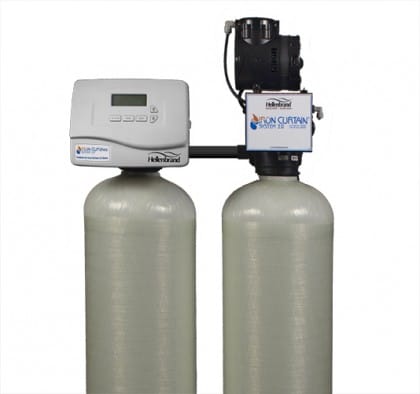
ProMate 6 Iron Curtain 2.0
The 2.0 is the two-tank system for heavier iron, more manganese or a strong sulfur smell. Hellenbrand calls the design Demand Aeration: a 110 volt air pump keeps a head of air in the first tank and recharges it based on the gallons you use. The second tank, a multi-media depth filter, traps the particles and backwashes them away. No air injectors or venturis to plug with iron.
- Rated for more iron, manganese and hydrogen sulfide than the Jr
- No salt and no chemical regenerant
- Standalone iron removal unit, does not soften water
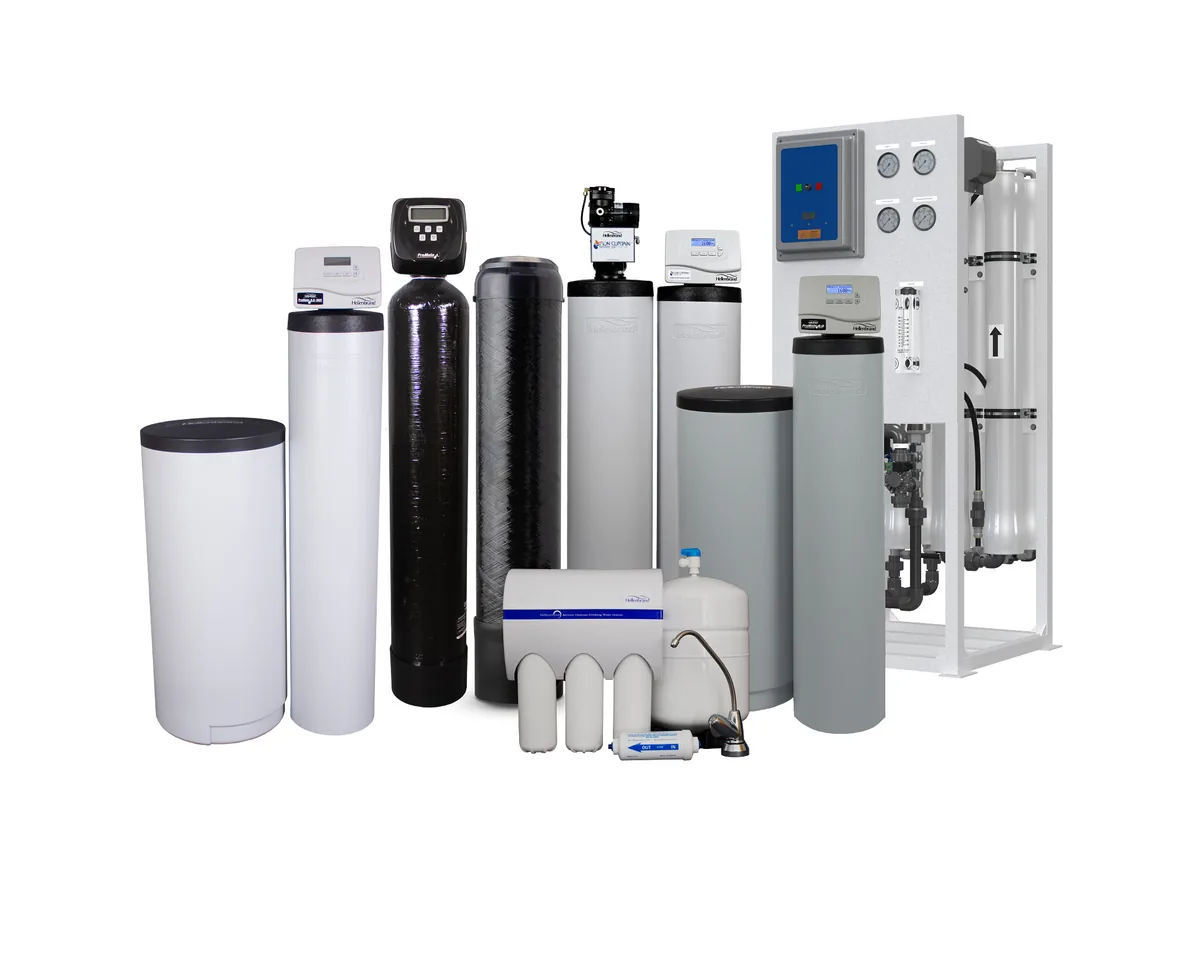
Custom Multi-Stage Systems
Some water goes past what either Iron Curtain is rated for: levels above the table below, several problems at once, low pH, tannins, or iron bacteria. For those homes our technicians design custom multi-stage systems from Hellenbrand components, built around your water test results, sometimes with whole house filtration alongside. Tannins above 0.5 ppm and bacteria fouling fall outside Hellenbrand's warranty, so we tell you what is covered before we build.
- Each stage sized to your household's flow rate
- Hellenbrand components, each under its own factory warranty
- Professional installation and ongoing local service
Which Iron Curtain Fits Your Water
These figures come from the Hellenbrand owner's manuals linked below.
| Your water test | Iron Curtain Jr | Iron Curtain 2.0 |
|---|---|---|
| Iron (clear-water or red-water) | up to 3.0 ppm | up to 10 ppm |
| Manganese | up to 1.0 ppm | up to 2.0 ppm |
| Hydrogen sulfide (rotten-egg odor) | up to 1.0 ppm | up to 10 ppm |
| Total dissolved solids | 500 ppm or less | 750 ppm or less |
| pH | 7.0 or higher | 7.0 or higher |
Hellenbrand rated each limit for that contaminant on its own, with nothing else in the water. When your water carries several at once, the filter may handle less of each, so your test decides the model, not the table.
Tannins are the other deal-breaker. The 2.0 manual says field tests show they will not be removed and will hinder the filter, the Jr manual says organics can tie up the iron and prevent filtration, and above 0.5 ppm they void performance claims on both.
Hellenbrand's installation record asks for iron, manganese, pH, hydrogen sulfide, dissolved solids, tannins, hardness and iron bacteria. Our free in-home water test is where we start. MDH recommends an accredited laboratory for testing your water, and we tell you which numbers need to go to a lab.
Why Chemical-Free Iron Removal Matters
Many iron removal systems oxidize iron with chemicals, usually potassium permanganate or chlorine injection. Here is what the Iron Curtain does instead, and where chemical-free stops.
Potassium permanganate or chlorine
They work, with drawbacks. MDH notes that regenerating an oxidizing media filter is messy and its chemicals can be harmful, and that chlorination needs monitoring, can create by-products, and often needs a carbon filter for the chlorine taste.
- Chemical to buy, store and handle
- Dosing needs monitoring
- May need a carbon filter for taste
The Hellenbrand Iron Curtain
The Iron Curtain uses the oxygen already in the air instead. In normal operation there is no salt, no potassium permanganate and no chlorine feed.
- No chemical to buy or store
- No chemical taste to filter back out
- Backwashes itself to the drain
Chemical-free has limits worth hearing before you buy
Hellenbrand says every water filter should be disinfected after installation, and some need it again later. The method depends on the media in your filter, so the manual sends you to your dealer. Iron bacteria are the bigger exception: both manuals say they have to be controlled with chlorine or another approved method for the filter to work properly, in some cases by chlorinating the water supply continuously.
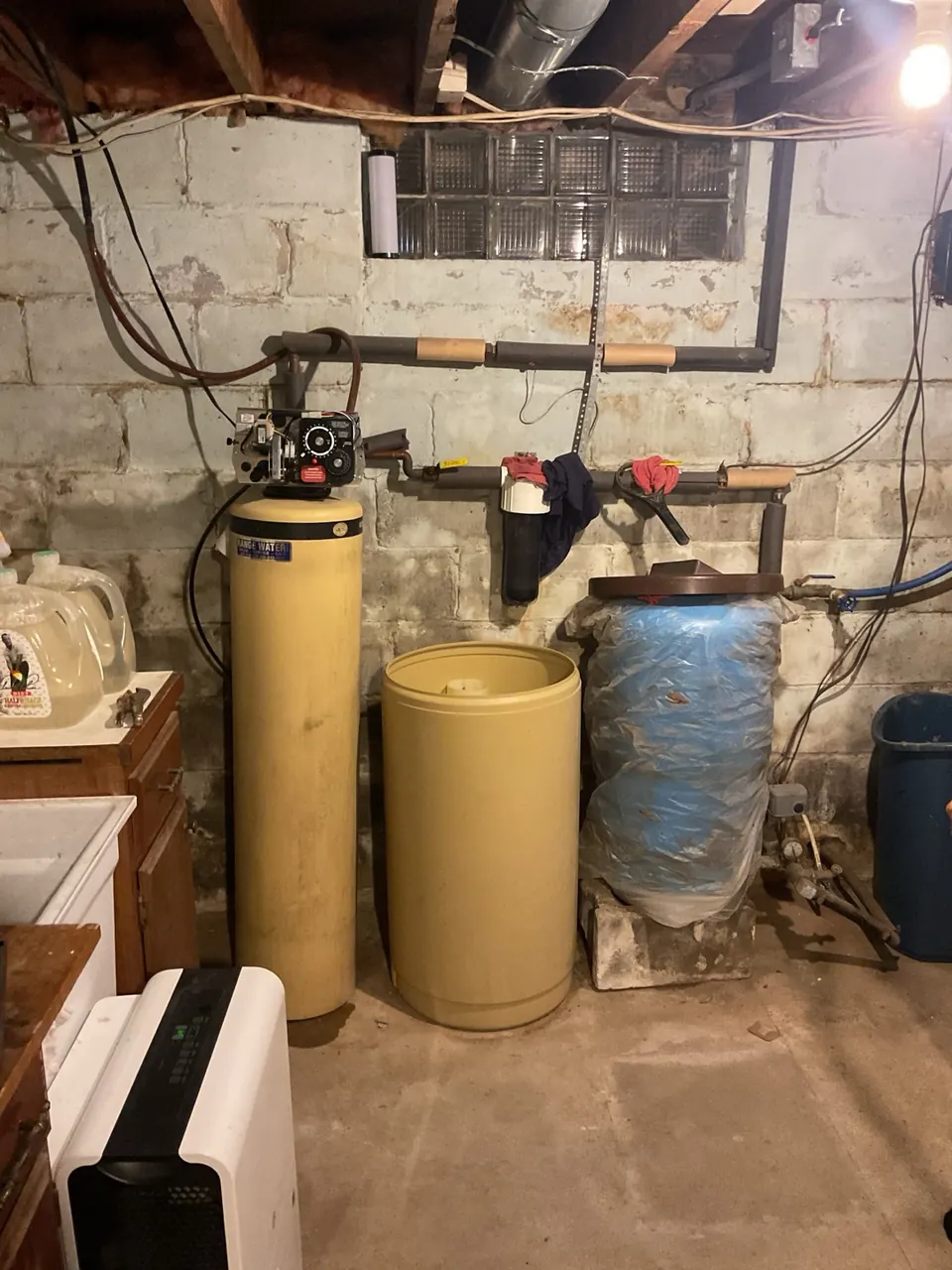
Sized to your well, not to a brochure
Our technicians install and service iron filters across the Iron Range, the Brainerd Lakes area and greater Duluth from our Grand Rapids, Duluth / Hermantown and Pequot Lakes stores.
Before recommending a model we check your well pump can deliver the flow a backwash needs. Start with a free water test and we'll show you what's in your water.
Get a Free QuoteProduct Resources & Manuals
The owner's manuals for the two systems we install. Every limit in the table above comes from them.
ProMate 6 Iron Curtain Jr
ProMate 6 Iron Curtain 2.0
Frequently Asked Questions
What causes orange and brown stains in Northern Minnesota well water?
Iron. When iron is exposed to air and oxidizes, it turns into rust-colored particles that settle on sinks, toilets, tubs, and laundry. Staining can start at 0.3 ppm of iron, and MDH calls iron above 0.3 mg/L usually objectionable.
What causes black staining in well water on the Iron Range?
Usually manganese, which travels with iron and stains brownish-black at very low levels. Test for it on its own, because MDH's guidance is health based: 100 micrograms per liter where an infant drinks the water, well under what either filter is rated to take in. Those ratings are not a promise about what leaves the tap.
How do you remove iron and manganese from well water in Northern Minnesota?
Through oxidation followed by filtration. The system converts the dissolved minerals into solid particles, traps them in a media bed, and flushes them away during an automatic backwash. Manganese oxidizes more slowly than iron. Hellenbrand's manuals say manganese reduction works best above pH 8.5, so we check your pH before sizing a filter for manganese.
What is the difference between iron staining and manganese staining in well water?
Iron staining is orange to reddish-brown, while manganese staining is black to dark brown. Both come from dissolved minerals that oxidize and leave deposits on fixtures and laundry, and one filter is normally sized for both. Manganese is harder on the filter: above the model's rating, Hellenbrand says it may gradually prevent iron removal.
Why is iron so common in Iron Range well water near Hibbing and Grand Rapids?
Groundwater picks up iron moving through soil and rock, and MDH notes some Minnesota soil and rock contain minerals very high in iron. Your own number is what counts: the iron content of two nearby wells may be quite different.
Will a water softener alone remove iron staining from my Iron Range well water?
Only if the iron is low and still dissolved. Hellenbrand rates its own softeners at up to 2 ppm of dissolved iron, and only if air is kept off the water first. MDH puts the common limit at 2 to 5 mg/L. When iron fouls the resin, Hellenbrand's own softener manual lists installing an Iron Curtain ahead of the softener as the fix.
Only my hot water smells like rotten eggs. Will an iron filter fix that?
Maybe not. MDH's first step is to find the source: after you have been away from home for a few hours, smell the hot and cold taps and note which ones carry the odor. If only the hot tap smells, MDH points at the water heater, which can produce hydrogen sulfide gas itself, and lists fixes done at the heater. If the cold taps smell too, MDH lists home water treatment among the options.
My water test came back with tannins. Will an Iron Curtain still work?
Not on its own. Hellenbrand's manuals say organic matter such as tannins prevents the oxidation step that turns dissolved iron into a filterable solid, and that tannins above 0.5 ppm void any claims for either Iron Curtain to perform as stated. Even below 0.5 ppm they can hinder it. MDH says the same of organic iron and tannins: they can slow or prevent iron oxidation, so softeners, aeration systems and iron filters may not work well.
Can an iron filter go in an unheated garage, shed, or cabin?
Only if the space stays above freezing and out of the weather. Both Hellenbrand manuals say the filter cannot be subject to freezing conditions, and the Iron Curtain 2.0 manual adds that its controls and air compressors are not designed to be installed outdoors with direct exposure to the elements, so Hellenbrand recommends indoors or under a protective shelter. It also warns that high humidity or a corrosive environment causes premature compressor failure. Both units also need a continuous 110 volt supply that cannot be switched off elsewhere.
Is my water treated while the filter is backwashing?
Not during the cycle itself. Hellenbrand's Iron Curtain Junior manual says that if there is a demand for water while the system is regenerating, untreated water will be supplied, which is why a system is typically set to regenerate at a time of low water use, such as when the household is asleep. The control works through the backwash steps on its own, shows the step and the time remaining, then resets itself to treated water when the cycle finishes.
Does an iron filter need a drain nearby?
Yes, the backwash has to go somewhere. Hellenbrand's Iron Curtain Junior manual says the filter should be located close to a drain and that overhead drain lines are best avoided because they create back pressure, and it caps an overhead drain at 8 feet above the floor and 20 feet in length. The Iron Curtain 2.0 manual sets a minimum drain line size of 3/4 inch. Both manuals also call for a bypass valve on the system.
Do I need a softener and an iron filter?
Only if your test shows both. An Iron Curtain does not soften and a softener handles only limited iron. MDH says you might need a softener once hardness passes 7 grains per gallon. The iron filter goes first and the water softener after it.
How do I know if I have iron bacteria?
Look in the back of the toilet tank. Iron bacteria leave a sticky rusty, yellow, brown or grey slime, and MDH's other signs are stained water, a rainbow colored oil-like sheen, and swampy or musty smells. A filter alone is not the fix. MDH starts at the well, where a licensed well contractor cleans the pumping equipment and scrubs the casing, then shock chlorinates the well and system.
What maintenance does an iron filter need?
Less than a chemical system, but not none. It backwashes on a schedule set by your iron level. Hellenbrand's yearly dealer checkup on the Iron Curtain Jr retests the raw water, confirms the settings, checks the air system and backwash flow, and looks for iron bacteria slime. Call our service and repair team if stains or odor come back.
Iron and Sulfur Removal Across Northern Minnesota
Iron levels differ well to well, so we test at your address. Here is where we install and service iron filtration.
Crow Wing County
- Brainerd
- Pequot Lakes
- Baxter
- Crosby
- Nisswa
St. Louis County
- Duluth
- Hermantown
- Hibbing
- Biwabik
- Virginia
- Eveleth
Itasca County
- Grand Rapids
- Hill City
- Deer River
- Cohasset
- Bigfork
Beltrami County
- Bemidji
- Blackduck
- Kelliher
Carlton County
- Cloquet
- Carlton
- Moose Lake
Koochiching County
- International Falls
- Littlefork
- Northome
North Shore
- Two Harbors
- Silver Bay
- Schroeder
- Tofte
Ready to Eliminate Iron Stains?
Schedule a free water test to find out exactly what's in your water.
Get Your FREE QuoteGet In Touch
Have questions about your water quality or our services? We're here to help!
Grand Rapids: +1 218-322-0575
Duluth / Hermantown: +1 833-659-5553
Pequot Lakes: +1 218-322-1793
Northern Minnesota
Grand Rapids, Duluth, Brainerd & Beyond
Monday - Thursday: 9:00 AM - 5:00 PM
Friday: 9:00 AM - 4:00 PM
Factory Authorized Dealer: